Publications · Khrystyna Didukh
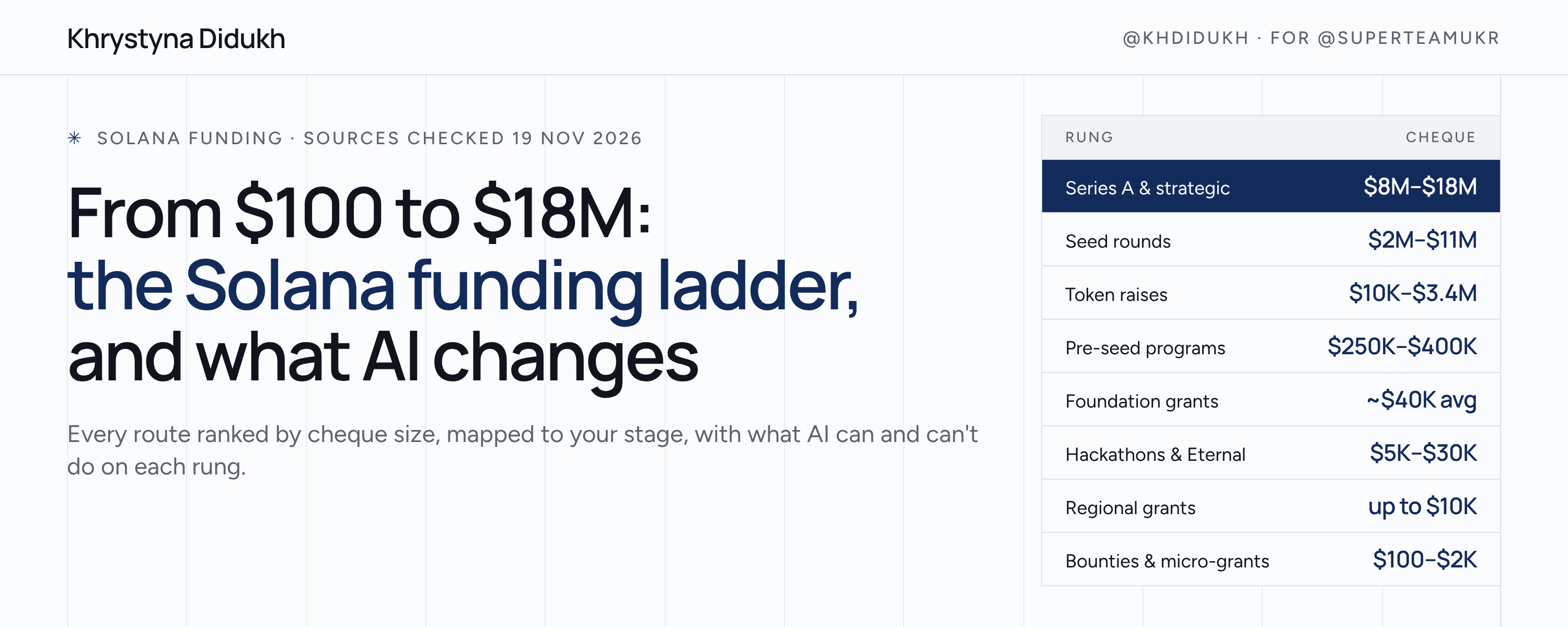
From $100 to $18M: the Solana funding ladder, and what one person with AI can climb
· Khrystyna Didukh
TL;DR
- Solana is becoming payment rails. It holds about $12.5B in stablecoins, Visa settles USDC with US banks on it, and Western Union launched its own stablecoin there in May.
- Funding runs from $100 bounties to $18M strategic rounds. I ranked every route by cheque size and mapped each one to five stages: idea, prototype, users, revenue, Series A.
- Every rung asks for a different level of readiness. The lower rungs need a laptop, a wallet and proof of work. The top rungs need revenue, a company and a lawyer.
- The standard first equity cheque is Colosseum's $250,000 (SAFE plus token warrant). You reach it by winning a hackathon or an Eternal sprint. About 0.7% of submissions get in.
- Token sales find a price, not a pile of money. Umbra drew $154.9M in commitments against a $3M cap.
- AI now carries much of the build, research and paperwork, especially on the lower rungs. It cannot do KYC, signatures, audits, investor relationships or traction for you.
- Grant availability changes. Check current status on Superteam Earn before you apply.
First, what Solana is
Solana is a public blockchain: a shared ledger that anyone can build on and no single company owns. The simplest way to think about it is payment rails and an app platform in one. You can send dollars as stablecoins, run a marketplace or build a consumer app, and transactions settle in seconds without a bank in the middle.
Two things set it apart. It is fast: since 9 October 2026 the network produces a new block every 200 milliseconds. And it is cheap: the base fee is 0.000005 SOL per signature, about $0.0004 at today's price of roughly $74 per SOL.
That is why real money is moving there. Solana holds about $12.5 billion in stablecoins, the fourth-largest pool of any chain, according to DefiLlama on 19 November. Since December 2025, Visa has offered US banks stablecoin settlement in USDC on Solana. In May 2026, Western Union launched USDPT, a dollar stablecoin issued by Anchorage Digital Bank, on Solana to settle with its agents around the world.
Who it is useful for:
- Founders building payments, remittances, treasury or stablecoin products.
- Consumer app builders who need cheap transactions at scale: games, loyalty, creator tools, mobile apps.
- Developers and researchers, who can get paid for open-source tools and public goods.
- Users and small businesses who want to move dollars across borders outside banking hours.
- Companies that want to accept stablecoins or put assets onchain.
Why I mapped this
This autumn I entered several crypto hackathons solo, building with AI. One of them was a Superteam Ukraine research bounty, "Inside the Block: How Solana Validators Order Transactions". I submitted it on 30 October, and the repo is public at github.com/khrisdidukh/solana-tx-ordering. I build my own products the same way: Veridom, a house-building control app; Phenomenon, a learning app; and i8, a calorie tracker on iOS. For Atlassian's Codegeist hackathon I built Bottleneck Economist, a Jira app now listed on the Atlassian Marketplace that finds where work gets stuck and whether automating a step would actually save money, which at company scale can mean millions. All of them with Claude Code and Lovable instead of a hired dev team.
Doing this, I kept asking which money is realistic for a small team right now. Most funding guides list programs. I wanted three answers for each one: how big is it, how ready do you need to be, and how much of the work can AI carry. Every figure below was checked against its primary source in November 2026. Where a number is a company's own claim, I say so.
The ladder, biggest cheques first
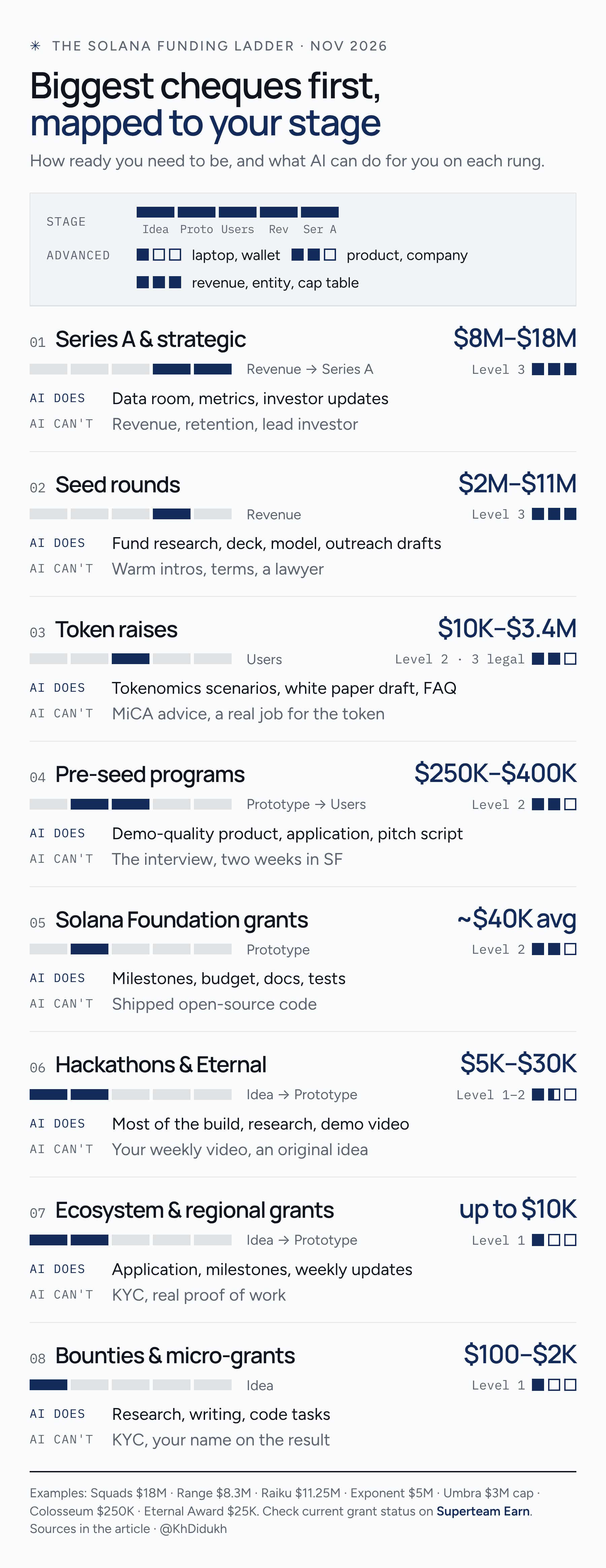
"How advanced" is a simple 1–3 scale. 1 means a laptop, a wallet and curiosity. 2 means a working product and someone who can sign a contract for a company. 3 means revenue, a legal entity, clean books and a cap table.
1. Series A and strategic rounds: $8M to $18M
Stage: revenue, Series A. How advanced: 3.
Squads raised an $18M strategic round led by Solana Ventures, with Coinbase Ventures and Haun Ventures, structured as priced equity and announced on 29 April 2026. Its Altitude stablecoin accounts had processed more than $200M. In June, Range closed an $8.3M Series A led by fintech funds TX Ventures and SixThirty, in what it called "one of the hardest fundraising markets crypto has seen."
Three patterns: priced equity replaces SAFEs at this level; fintech investors now sit next to crypto funds; and news lags the money. Squads raised between October and December 2025 and announced in April.
AI does: prepares the data room, builds metrics views from onchain and payment data, drafts investor updates and due-diligence answers. AI can't: produce the revenue, the retention curve or the lead investor's trust.
2. Seed rounds: $2M to $11M
Stage: revenue (sometimes strong usage). How advanced: 3.
- Exponent, a yield exchange: $5M seed led by Multicoin Capital, with Solana Ventures, RockawayX and Anatoly Yakovenko as an angel (April 2026).
- Raiku, transaction-inclusion infrastructure: a $2.25M pre-seed, then an $11.25M seed led by Pantera with Jump Crypto. Both were SAFEs with token warrants (September 2025).
- Multiliquid, live on Solana and Ethereum: $8M across a SAFE pre-seed and a priced seed led by Polychain, with no token planned (October 2026).
A token warrant gives investors a right to tokens if you ever launch one. Decide your token plan before you sign, not after. And no token is a legitimate choice: Multiliquid raised without one.
AI does: builds a target list of funds that wrote Solana cheques, drafts tailored outreach, iterates the deck, scaffolds the financial model, runs mock investor Q&A. AI can't: get you a warm intro or tell you which terms you can live with. That is your lawyer's job and yours.
3. Token raises: $10K to $3.4M
Stage: users. How advanced: 2 technically, 3 legally if you sell to EU residents.
MetaDAO runs raises governed by futarchy, where prediction markets decide key spending. Umbra (October 2025) drew $154.9M in commitments against a $3M cap, so backers received roughly 2% of what they offered. Rip Cars capped its raise at $250,000 against $31.9M in commitments. MetaDAO's permissionless arm, Backable, lets anyone raise $10,000 to $2M for a $15 listing fee; the team draws a monthly budget capped at one-sixth of the goal. A new Apps Program targets consumer apps with smaller raises: the AI SAT-prep app 1609SAT opened a $100,000 raise on 5 November, with MetaDAO contributing $50,000. Metaplex Genesis reports $13M+ across nine sales, including Collector Crypt ($3.4M) and DefiTuna ($2.5M, sold out in four minutes).
The caveats are real. Demand is not capital. Governance can be thin: eight traders decided the vote to unlock Rip Cars' treasury. Backable's own docs say "nobody checks whether the teams are real, honest, or capable." Under MiCA, a public token offer in the EU needs a white paper unless an exemption applies, such as under €1M over 12 months or fewer than 150 people per member state.
AI does: models token-supply and vesting scenarios, drafts the white paper and community FAQ, translates them. AI can't: give a legal opinion, make a market, or invent a reason for the token to exist inside your product.
4. Pre-seed programs: $250K to $400K
Stage: prototype to first users. How advanced: 2.
- Alliance (any chain): $400,000 at a $4M post-money SAFE with a 1:1 token side letter. Alliance says its median startup goes on to raise $3.5M at $25M post-money. It runs three cohorts a year; the next, ALL19, starts on 11 January 2027.
- Rsidency × Construct (Fabric Ventures and Wintermute): $300,000 per team for equity plus a future token allocation, in London and New York. The 2026 cohort closed applications on 15 September.
- Colosseum accelerator: $250,000 before the program starts, through a SAFE plus token warrant or STAMP. The only way in is to win a hackathon or Eternal. In the latest cycle, 21 teams were accepted from more than 3,000 submissions. Twelve weeks, the first two in San Francisco. The Solana Foundation says alumni have raised more than $650M.
A path that worked this year: CrowdBrain, a robotics DePIN team from Georgia, won the $30,000 grand prize at Colosseum's Frontier hackathon (2,857 projects) and joined Accelerator Cohort 5.
AI does: gets the product to demo quality fast, drafts the application, scripts the one-minute pitch video, runs mock interviews. Colosseum even gives accepted founders AI credits from OpenAI and Anthropic. AI can't: sit the interview or spend two weeks in San Francisco for you.
5. Solana Foundation grants: about $40K on average
Stage: prototype. How advanced: 2.
The Foundation funds milestone-based grants for public goods, convertible grants for public goods with a commercial side, and RFPs for ideas it wants built. Its test has four parts: public good, open source where usable, a clear reason it only works on Solana, and a budget tied to measurable milestones. "Projects that are primarily commercial in nature usually won't qualify for a standard grant." In March, CPO Vibhu Norby put the average open-source or public-good cheque at about $40,000.
On 9 November the Foundation published a Request for Startups with 11 ideas, from onchain housing futures to an AI financial adviser inside a wallet. It points founders to a Solana Builder Program; grant sizes and deadlines are not published yet.
AI does: drafts the milestone plan and budget, writes docs and tests, maps your idea against the Request for Startups. AI can't: replace shipped open-source code. Reviewers fund what they can see working.
6. Hackathon prizes and the Eternal Award: $5K to $30K
Stage: idea to prototype. How advanced: 1–2.
Colosseum's autumn Crypto World's Fair (14 September to 12 October) carried $840,000 in prizes: a $30,000 grand prize, $15,000 each for the next 20 projects, a $100,000 Solana track (10 × $10,000) and $5,000 public-good and university prizes. Colosseum runs two main hackathons a year, in April–May and September–October. Between them runs Eternal: a four-week sprint you start yourself, with a one-minute video update every week and a reply within 14 days. The $25,000 Eternal Award goes to the most innovative submission each half-year, for teams that have not raised VC. Start a sprint by 20 March 2027. You give up nothing.
AI does: this is where AI changes the most. Claude Code writes and tests the Solana program on devnet; Lovable builds the front end; AI researches past winners, scripts the demo and drafts the submission. AI can't: record your weekly face-to-camera update or make a borrowed idea original.
7. Ecosystem and regional grants: up to $10K
Stage: idea to prototype. How advanced: 1.
Superteam runs regional Solana Foundation grants on Earn of up to $10,000. The Ukraine listing describes milestones you set yourself, a decision in about a week, regular public updates and one line worth keeping on your wall: "Proof of Work > Credentials." Availability differs by region, so check current status on Earn. Solana Mobile Builder Grants are open for mobile-first apps that integrate the Solana Mobile Stack, paid against milestones. Protocol programs exist too: Jupiter DAO's first run paid a median grant of $8,000. Confirm any protocol program is live before you write.
AI does: drafts the application and milestone plan, writes the weekly public updates, translates them. AI can't: pass KYC or invent proof of work that does not exist.
8. Bounties and micro-grants: $100 to $2,000
Stage: idea; you do not need a project. How advanced: 1.
@SuperteamUKR puts typical Earn bounties at roughly $100 to $2,000+ per task and says it has helped Ukrainian builders collect more than $1M across grants, prizes and bounties. One detail tells you where the ecosystem sees leverage: Superteam's Agentic Engineering Grants pay $200 for a month of a top-tier AI coding tool, half upfront after KYC and half once you ship a working product with Solana integration. Earn shows $62,200 approved across 311 recipients. Check current status on Earn.
AI does: research, writing and code bounties end to end, under your review. AI can't: take responsibility for what you submit under your name.
By stage: where to start
- Idea: bounties, micro-grants, an Eternal sprint. Build proof of work in public.
- Prototype: hackathons, regional and Foundation grants, Solana Mobile if you are mobile-first.
- Users: the Colosseum route to $250,000, Alliance, carefully chosen token raises.
- Revenue: seed funds that wrote Solana cheques in 2025–26, plus fintech VCs if you move stablecoins.
- Series A: strategic investors who bring distribution. Show payment volume and retention, and plan for months between close and announcement.
What you need to do it with AI
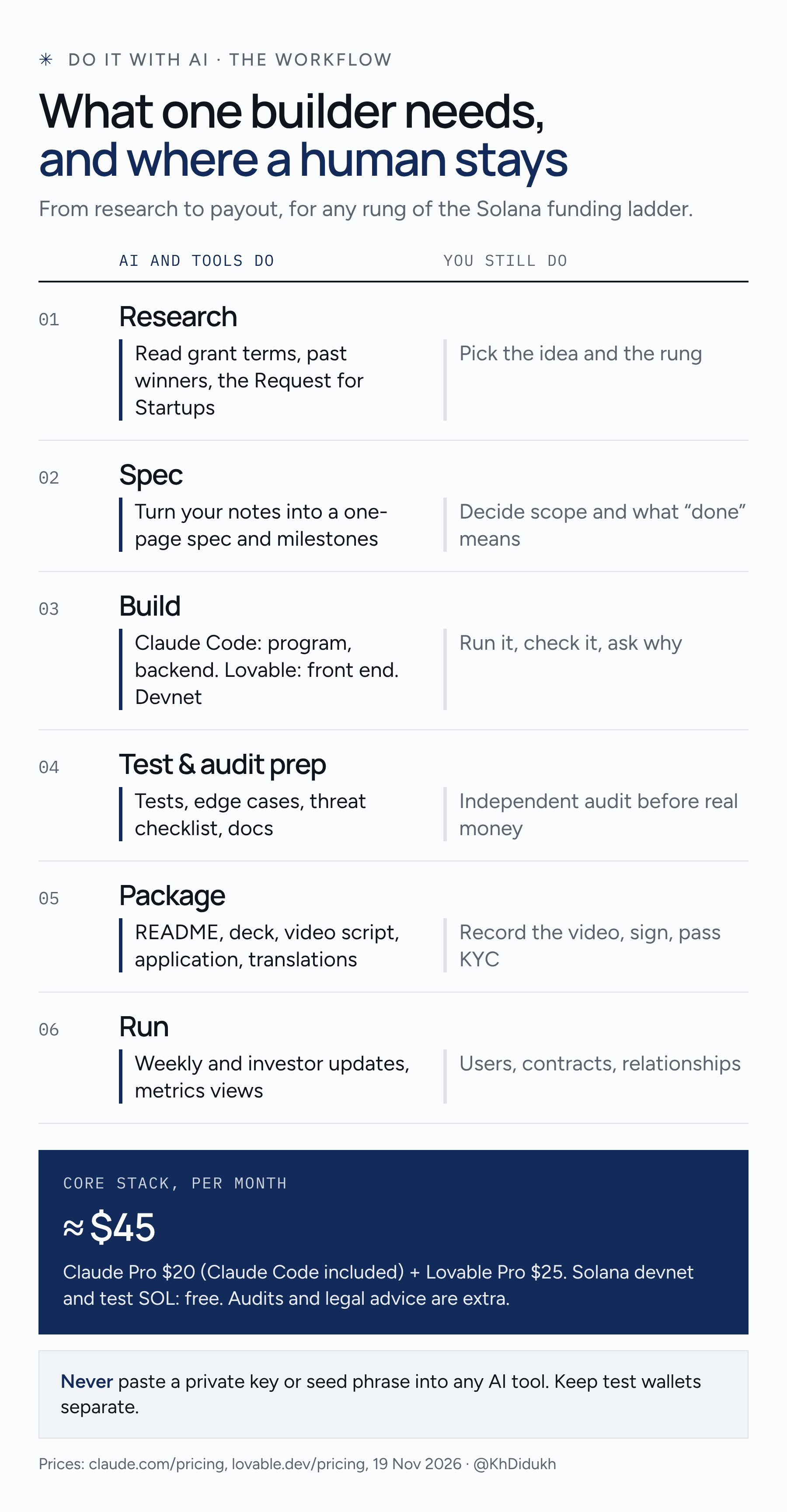
The stack
- Claude Code for the Solana program, backend, refactoring and tests. It is included in Claude Pro at $20 a month; heavier tiers cost $100 and $200.
- Lovable for the front end, landing page and dashboards, synced to GitHub. Pro is $25 a month.
- Solana devnet with free test SOL, so you can break things without losing money.
- A public GitHub repo. It is your proof of work.
- The same AI assistant for research, the deck, the video script, translations and investor updates.
The core costs about $45 a month. Audits and legal advice are separate, and they are where you should spend real money.
The skills
You do not need to write Rust. You do need four things. Write a precise spec: what the product does, for whom, and how you will know it works. Read AI output critically: run it, test it, ask why it made a choice. Keep wallet hygiene: separate test wallets, and never paste a private key or seed phrase into any AI tool. And pitch in English, because the judges and investors work in it.
The workflow and the time
Colosseum's own formats assume four weeks: a hackathon runs about four weeks, an Eternal sprint exactly four. My loop inside that window: research the program, write the spec, build in small steps with Claude Code and Lovable, make AI write the tests and docs as it goes, then package the submission. The time you save on code goes into what judges actually read: the problem, the demo and the proof.
Where a human is still required
- KYC and payouts. Superteam- and Solana-sponsored payouts require winners to pass KYC.
- A company. Grants, SAFEs and token warrants need a legal entity on the other side. An Estonian OÜ run online through e-Residency works for many non-US founders; the card fee becomes a flat €165 from 1 January 2027.
- Legal sign-off, especially for token terms and MiCA. Since 1 July 2026, crypto-asset service providers without MiCA authorisation must stop serving EU clients.
- Security audits by independent humans before real money touches your contract.
- Keys and treasury: multisig, signing and accounting stay with you.
- Relationships, interviews and in-person weeks.
- Users. No model can download your app for you.
The window
For ten years I ran an import business in Ukraine. Every new channel, every website and app, meant hiring people, paying them and waiting. The idea was the cheap part; execution was expensive and slow.
That balance has shifted. With AI, one person can now research a grant program, build a working product, test it, write the documentation, cut the demo and draft the application. A year or two ago that needed a team. The money on the lower half of this ladder, from bounties to hackathon prizes to the first $250,000, is open to anyone who ships. It does not ask for a computer science degree. It asks for proof of work.
So I see a golden window for non-technical builders right now. Ideas and the speed of execution matter again, because the cost of trying has dropped so far. The window will not stay this wide: when everyone builds with AI, a working demo stops being rare. What will not get cheaper is judgment, taste, trust and real users. Use the window to collect those.
This is also what I see inside companies. The teams that win with AI are not the ones with the most licences. They are the ones where people learn to use it on their real work, and keep a human where a human is needed.
Written for builders in the Solana ecosystem and for @SuperteamUKR. If you are in Ukraine, follow them for the next grant window.
Khrystyna Didukh is a Ukrainian founder based in Vienna: founder of Veridom, co-founder and CTO of Avara Bio, Estonia e-Residency Envoy and a UNDP Woman Innovator. She ran an import business in Ukraine for ten years and now helps companies adopt AI at khrystynadidukh.com.
Sources
Solana basics
- Solana, reduced slot times (200 ms since 9 Oct 2026): https://solana.com/upgrades/reduced-slot-times
- Solana docs, transaction fees: https://solana.com/docs/core/fees
- SOL price, CoinGecko API (19 Nov 2026): https://www.coingecko.com/en/coins/solana
- Stablecoins by chain, DefiLlama (19 Nov 2026): https://defillama.com/stablecoins/chains
- Visa USDC settlement on Solana (The Block, 16 Dec 2025): https://www.theblock.co/news/business/2025-12-16-visa-launches-stablecoin-settlement-us-circle-usdc-solana-382721
- Western Union USDPT on Solana (The Block, 4 May 2026): https://www.theblock.co/news/markets/2026-05-04-western-union-launches-usdpt-stablecoin-anchorage-solana-399890
Rounds
- Squads (The Block, 29 Apr 2026): https://www.theblock.co/post/399386/solana-ventures-squads-funding-stablecoin-altitude
- Range Series A (18 Jun 2026): https://range.org/blog/range-raises-series-a-to-unify-treasury-risk-and-compliance-across-rails
- Exponent seed (The Block, 30 Apr 2026): https://www.theblock.co/post/399630/solana-yield-exchange-exponent-funding-multicoin-capital
- Raiku (The Block, 23 Sep 2025): https://www.theblock.co/post/371969/raiku-solana-project-funding
- Multiliquid (The Block, 15 Oct 2026): https://theblock.co/news/deals/2026-10-15-multiliquid-tokenized-assets-funding-418693
Token raises
- Umbra ICO (The Block, 10 Oct 2025): https://www.theblock.co/post/373997/solana-arcium-privacy-protocol-umbra-ico-metadao
- Rip Cars ICO: https://solanacompass.com/news/metadaos-rip-cars-ico-closes-127x-oversubscribed-with-319m-in-commitments
- Rip Cars treasury vote (18 Oct 2026): https://pro.edgex.exchange/en-US/news/article/rip-cars-passes-250000-treasury-proposal-metadao
- MetaDAO Backable (Colosseum Codex, 8 Oct 2026): https://blog.colosseum.com/metadao-backable-solana-dvp-web3js-v3/
- MetaDAO Apps Program and 1609SAT (Colosseum Codex, 6 Nov 2026): https://blog.colosseum.com/solana-protocol-spec-asset-registry-metadao-apps/
- Metaplex Genesis: https://www.metaplex.com/founders
- MiCA Article 4: https://www.esma.europa.eu/publications-and-data/interactive-single-rulebook/mica/article-4-offers-public-crypto-assets-other
- End of MiCA transitional period (AMF, 23 Jun 2026): https://www.amf-france.org/en/news-publications/news/end-mica-transitional-period-esma-sets-out-its-expectations-professionals-and-warns-retail-investors
Programs, grants and prizes
- Alliance: https://alliance.xyz
- Rsidency × Construct: https://solanacompass.com/news/fabric-ventures-and-wintermute-combine-accelerators-to-back-8-solana-founders-with-300k-each
- Colosseum Accelerator: https://www.colosseum.com/accelerator
- Colosseum Cohort 5 (29 Jun 2026): https://blog.colosseum.com/announcing-colosseums-accelerator-cohort-5/
- Colosseum Frontier hackathon winners (26 Jun 2026): https://blog.colosseum.com/announcing-the-winners-of-the-solana-frontier-hackathon/
- Colosseum Crypto World's Fair: https://www.colosseum.com/worldsfair
- Colosseum Hackathon calendar: https://www.colosseum.com/hackathon
- Colosseum Eternal: https://www.colosseum.com/eternal
- Solana Foundation, Grants and Funding: https://solana.org/grants-funding
- Vibhu Norby figures (KuCoin News, 24 Mar 2026): https://www.kucoin.com/news/flash/solana-foundation-defends-support-for-builders-amid-community-debate
- Request for Startups (crypto.news, 9 Nov 2026): https://crypto.news/solana-11-startup-ideas-ai-stablecoins-housing-futures/
- Colosseum Codex on the Request for Startups (12 Nov 2026): https://blog.colosseum.com/request-for-startups-sfdp-changes-breakpoint-schedule/
- Superteam Earn, Solana Foundation Ukraine Grants: https://superteam.fun/earn/grants/solana-foundation-ukraine-grants
- Superteam Earn, Agentic Engineering Grants: https://superteam.fun/earn/grants/agentic-engineering
- Superteam Ukraine (bounty range, $1M+ claim): https://ua.superteam.fun
- Superteam Earn FAQ (KYC for winners): https://docs.superteam.fun/the-superteam-handbook/community/faqs/superteam-earn-faq
- Solana Mobile grants: https://solanamobile.com/grants
- Jupiter DAO grants post-mortem (26 Jun 2025): https://discuss.jup.ag/t/grants-program-post-mortem/38973
AI tools and admin
- Claude pricing (Claude Code included in paid plans): https://claude.com/pricing
- Lovable pricing: https://lovable.dev/pricing
- e-Residency fee change: https://www.e-resident.gov.ee/en/blog/posts/changes-to-e-residency-in-2025-and-beyond
20–30 minutes · No commitment · Get a reply within 24 hours